I am pushing the pram to the supermarket, along the straight path that separates allotments from a newer housing estate. A power station once stood here and I remember standing at our back door on the day they blew up the cooling towers, not long after my third birthday. Now there is a ditch full of nettles edged by thick hawthorn to my left and a bank of grass to my right, beyond which bland 1990s houses rise.
My five-year-old is at home, helping his dad plant sweetcorn in neatly ordered seed trays that are spread across our garden furniture. The baby has just fallen asleep, her face turned into the gaping hood of her spring jacket. All I can see of her is a globe of smooth, pink cheek and glistening golden hair.
Pausing for a moment in the sunlight, I instinctively take my phone from the bag slung across the pram handles. Muscle memory wants me to open Instagram or emails, but instead I open the camera and snap a photo of my baby. I send it to my family Whatsapp and then notice that my breath is all up in the top of my ribcage; if I’m going to heal I need to breathe deeply into my core. That’s how the muscles mend and the mind calms.
I don’t know what to do with all this adrenaline, so I point the camera at the coppice lining the path and film a ten-second video. I’m drawn by the euphony coming from a large flock of sparrows full of spring excitement.
Their chatter is joyous and I want to capture their chorus as part of a nature archive I am building for reasons I don’t yet know. Satisfied, I place my phone in my bag and continue on.
The baby stirs and I see the first butterfly of the year.
When my babies were born I knew they were mine in a really primal sense. But when I looked at them - just looked at them - they were little strangers, otherworldly creatures, whose faces were a mystery. They didn’t look like mine. But my god, I knew them by smell. And I knew their cry from the very first moment. It wrenched at my heart and pulled at me in a way no other sound has ever done before or since. And I knew them by touch. Just exactly how my baby felt in my arms, their bodily heft, the shape of the elbows that I once felt from within.
As an adult, the natural world was at the edges of my life before children. In London, at best, I would notice the buddleia that sprang forth from between graffiti and bricks on high railway arches. Little hopeful glimpses of green and lilac life against the flat neon and grey brick walls that lined my commute. On the same commute I’d play a game with myself: no scrolling on my phone until I spotted a fox.
Birth made something different of me, turning me back towards an animal self that was emerging through motherhood and matrescence.
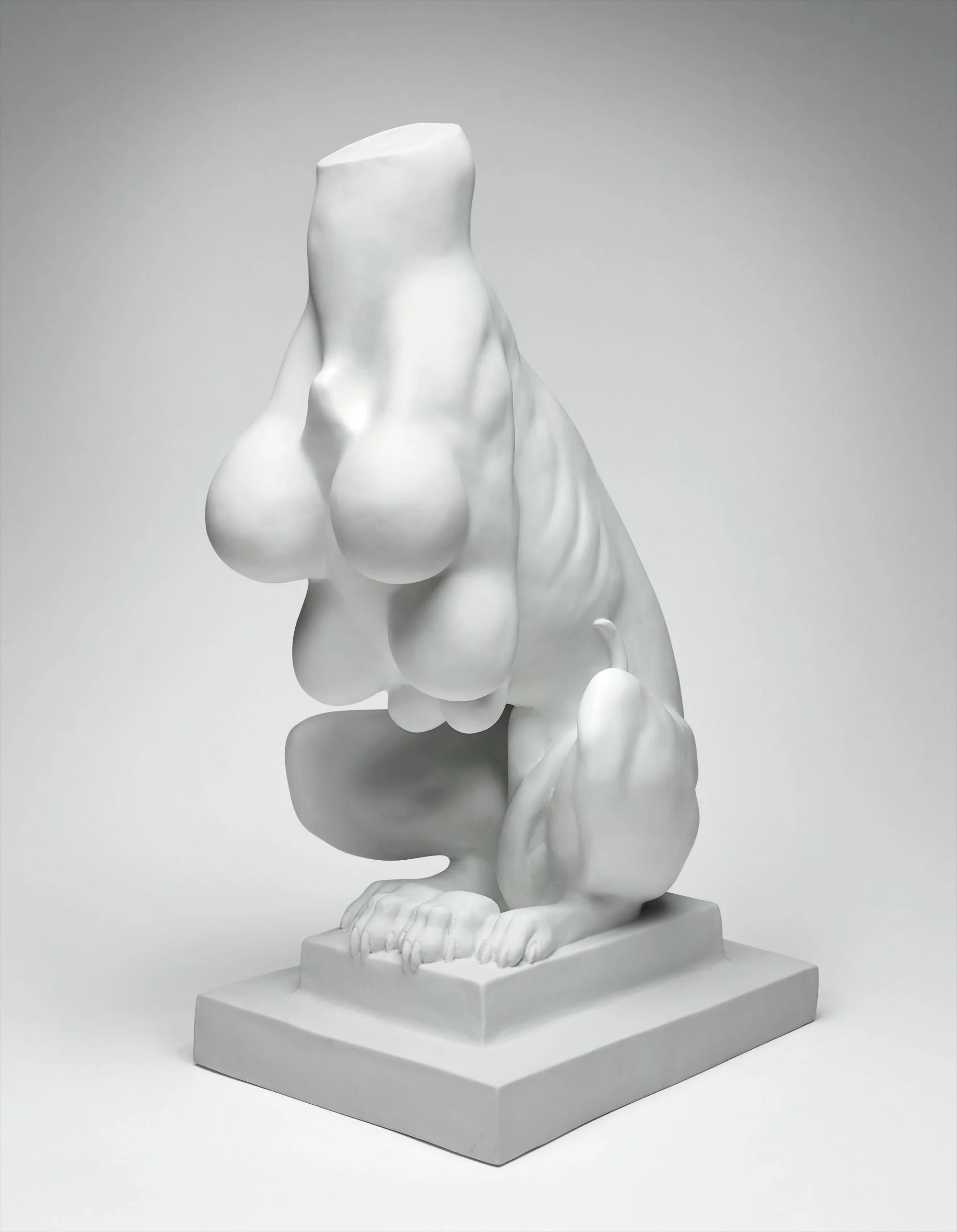
Louise Bourgeois, Nature Study, 2004
There was an animalistic ferocity in those first hormone-driven days after giving birth. I write about it in my book, Milk. I write of Bourgeois’ Nature Study (2004), an ambiguous sculpture standing at under a metre tall. The fragility of the porcelain contrasts with the ferocity of the headless canine-like creature, sat back on all fours, three pairs of swollen breasts presented to the viewer. Here is a mother in all her fullness, ready to pounce.
Is this what feminist Adrienne Rich meant by the power of mothering? Ribs showing, claws prominent: Bourgeois’ creature is the snarling mother I wanted to be when a health visitor grabbed my son’s head in an effort to get the baby to latch.
From placenta to milk to touch to gaze to soft nuzzle, I was connecting my baby to earth, to the ecosystem, to a culture that was getting bigger and more expansive with each passing week.
Katsi Cook, an Elder Mohawk and Kanienkehaka midwife in the Nation of Akwesasne, had famously said:
‘Woman is the first environment’
I’ve been thinking about this phrase a lot lately.
I had often thought of the environment as simply a place, but now understand it as the synaptic connections between things, encompassing the interconnectedness between the biosphere, societies, and cultures.
I was thinking about all of this during our summer camping trips in the woods, surrounded by abundant life and decay. As I was explaining the delicate balances of the natural world to my ever-curious five-year-old, in whose questions I was sensing a keen desire to understand his own place within the world. I was thinking of this as I was pondering my own forty-year-old face in the mirror, wondering how I might stop its inevitable decay.
I am thinking about my own womanhood, as I find myself in what I hope — if I’m lucky — is the middle of life. About how I see so many of the people I loved finding ways to connect ever more closely with the natural world. As my body nurtures new life and I feel more in tune with the seasons, my own decay and demise comes into sharper relief. I notice how much my own reflection looks like my mother’s. In the photo of me with my new baby, my aunts agree I looked exactly like my grandmother had.
Motherhood is also a reckoning with mortality.
I recently spoke with my good friend, who’s a poet. She told me she tries to avoid the autobiographical in her writing and really doesn’t want to write about her motherhood at the moment, even though it is a huge part of her life. She has two primary-aged children.
She was more nuanced in her telling of how she keeps her poetry and her motherhood separate. And I’m sorry I’ve flattened it out into such a bald and binary statement. I’m sure it’s not that binary in reality, but I do think it’s interesting to imagine the different ways we allow mothering to come into our work, consciously and unconsciously.
I envy her. I’m brimming with themes I want to explore on the page, and the two book proposals I’m working on are not about motherhood. But most often, it is thoughts of mothering that come out onto the page.
Perhaps it’s because a large chunk of my ‘writing time’ is actually time spent thinking about things while nursing a drowsy infant into sleep or doing the washing up.
Maybe it’s because I’m impatient, so the immediacy of this experience satisfies my impulses.
Maybe I’m lazy and solipsistic.
Being a mother is one of the least interesting things about me. I’m a woman in my forties with two kids, groundbreaking.
But while having children is banal, what that having does is wildly interesting.
Oh, of course, when a baby is born so is a mother. And, yes, didn’t we all get told by a stranger ‘just you wait, it changes everything’ as they eyed up our bump?
But what that means, physically, emotionally, spiritually, psychically? None of that feels banal.
The whole process of it all: a body becoming a dwelling, the cleaving open, touching death, the daily whiplash of life and how it all keeps changing as they grow and you grow and life spins its webs.
Maybe this is why so many of us find it so fucking, maddeningly difficult to mother in our present age, intensively and isolated as we fill our eyeballs with curated squares of self doubt.
None of that is boring.
If any of this resonates, I’d love for you to join me in September for another iteration of my Picturing Mothers workshop.
There is a choice of two dates for the half-day live, online workshop, which explores how motherhood has been represented, idealised, politicised and reimagined through art across cultures and history.