I am a mammal. Mothering is both easy and harder when I lean into that fact.
I’ll be exploring this idea in a live online workshop next Thursday, 5th November. In Our Animal Selves we will spend an hour together in dialogue with Louise Bourgeois, especially her Maman series. This is a one-off workshop and there are still a few spaces left. Tickets from £8.
We see the animal in our human babies. My squirrel who was all cheeks and furtive, darting eyes, my snuffling truffle piglet, snuggling little pangolin. Did you have an animal baby? I bet it was cute.
I’ve heard us mothers refer to ourselves as animals too; milky bed cows, hormonal she-wolfs, protective mama bear.
If my protective ferocity (and I definitely snarled at my partner more than once in the very early weeks) exceeded the humane it was at least a more glamorous reward for my motherly body that was otherwise bovine, bloody, and half-mauled.
I read Night Bitch as non-fiction.
I don’t remember ever thinking of abandoning my baby to the wilds, but I do recall how soothing it felt to picture myself walking away, alone and unencumbered, to the overgrowth of the nearby great Victorian cemetery. Daydreams (nightscapes) of my own abandon.
In mythical worlds, stories abound of babies abandoned to the wilderness, pressing onto them a wild otherness that later distinguishes them from the rest of the human population. But never the mothers.
Alone, these babies often find nourishment and care by being adopted into animal groups. Animal milk provides a counterpoint to the monstrous behaviours of the humans in these tales. The murderous uncles or jealous fathers.
According to Greek myth, Zeus’ mother hid him in a cave to protect him from his infanticidal father. Alone, Zeus was nursed by Amalthaea, a nymph who fed him goat milk. Amalthaea is sometimes represented as a goat herself, nursing the young god from her teats.
Jupiter was brought up by two nymphs and nurtured with goat’s milk and honey.
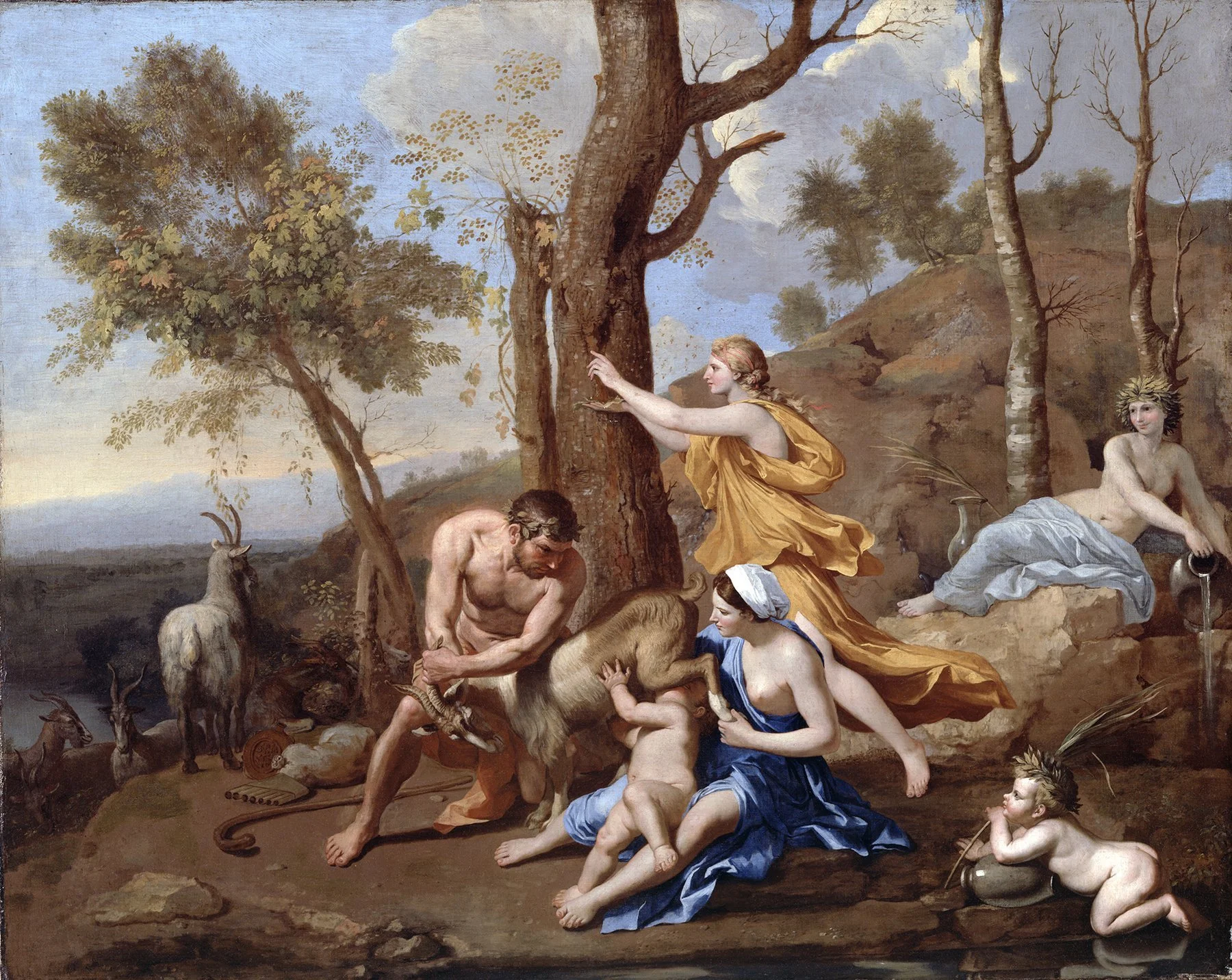
The Nurture of Jupiter, Nicolas Poussin, circa.1636-7, Dulwich Picture Gallery
Heracles, whose own breastfeeding from Hera created the Milky Way, had a son, Telephus. Some stories say this boy was suckled by a doe. In the Pergamon Altar, a frieze shows Telephus being breastfed by a lioness.
Romulus and Remus, the legendary founders of Rome, were ordered by their uncle Amulius to be drowned in the Tiber River. Amulius had good reason to fear his nephews reaching adulthood, given he had murdered all of their male relatives and imposed chastity on their mother, Rhea Silvia, who nevertheless was later assaulted and impregnated by Mars, the god of war.
But Amulius’ servants took pity on the twins and instead abandoned them on the riverbank where they were eventually saved by a she-wolf.
Captured in a famous bronze, now in the Capitoline Museum in Rome, two infants sit beneath the wolf’s teats, their heads tilted up to catch her milk. There is some debate as to whether this particular wolf dates to the Roman period or later, but it is known that the brothers were later additions to this scene, their fleshy roundness contrasting with the wolf’s sinewy frame. She stands alert, eyes wide and ears pinned back. Her expression is a familiar mix of protective and fierce mothering, but her pose is also unusual in its ambiguity. Her jaws open slightly to reveal her fangs and she is panting, perhaps snarling, and her kindness is represented as instinctual, almost accidental. Rather than reclining to feed, she stands as if caught in a moment and poised to run. She is ambivalent at best about these strange boys feeding from her, as if she is not even aware they are not her own cubs.
In Norse mythology Ymir (also known as Aurgelmir), a giant and the first being, was fed by a cow.
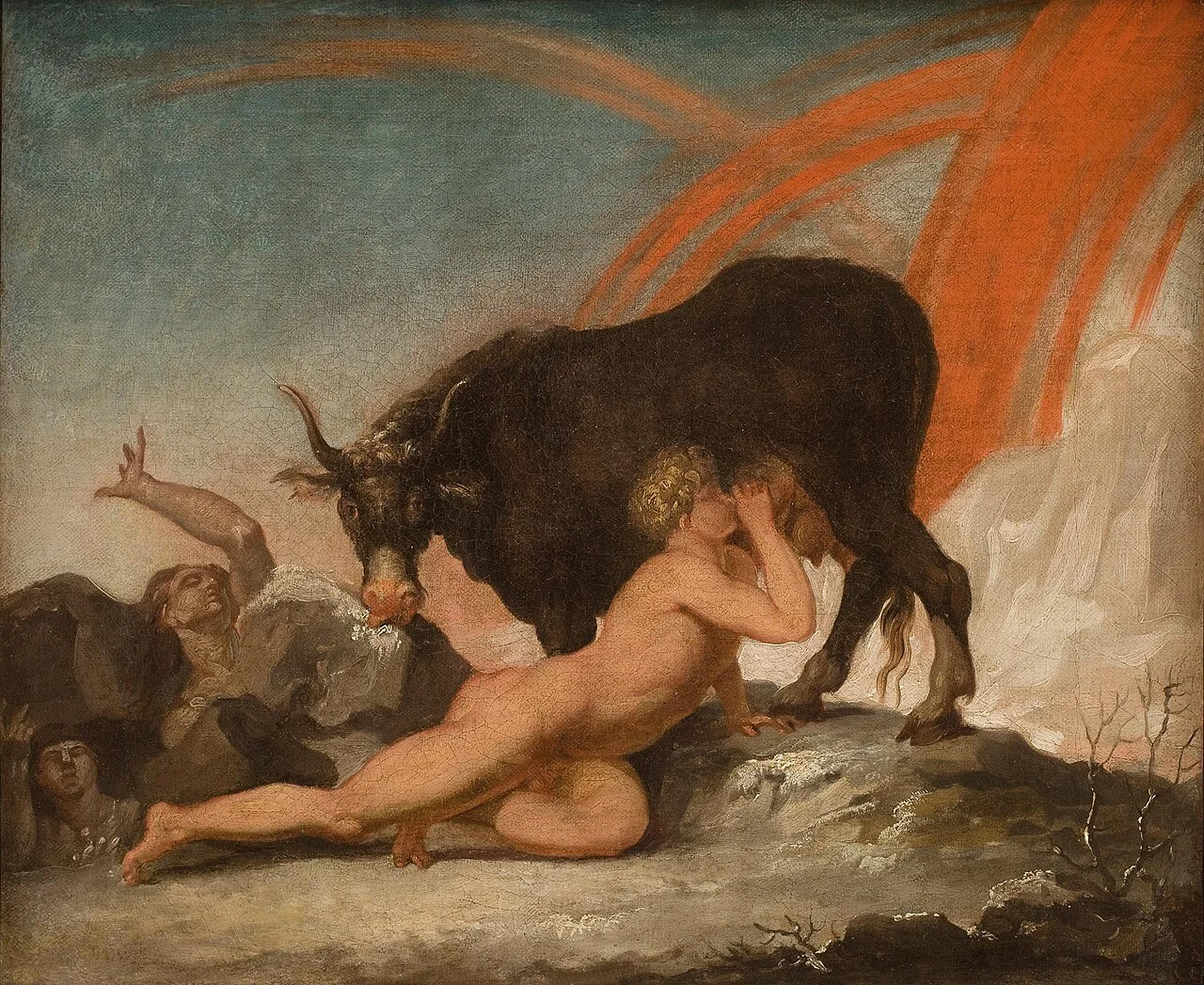
Ymer dier koen Ødhumble, Nicolai Abildgaard, 1777
Nourishment from animals marks these infants apart from other mortal, everyday babies, emphasising their otherness. The fierce she-wolf’s act of kindness in nourishing the foundlings is a powerful counterpoint to the savagery of murderous men and rapist gods.
But, in reality, humans have turned to mammal milk for thousands of years at least.
Evidence from prehistoric bottles suggests animal milk was a part of the diet, at least for older babies and infants. At other times, animal milks were distrusted, given lingering fears over the baby absorbing the qualities of the animal.
Italian writer Paolo de Certaldo issued a stark warning that an infant:
‘nourished on animal milk does not have wits like one fed on women’s milk, but always looks stupid and vacant and not right in the head’.
Wet nurses were often the preferred option.
But when wet nursing wasn’t possible, there are instances of babies suckled directly from animals. A text from the early 14th-century recommends feeding a child suffering from pulmonary tuberculosis directly from a cow’s udder.
Several 18th-century engravings show babies in foundling hospitals being fed by goats. This was a relatively common practice from the sixteenth century onwards in France, as syphilis spread across Europe and the risk of infected babies passing the disease to wet nurses was widely discussed by physicians. Consequently, alternative feeding methods were needed and goat milk was found to have a better success rate than feeding infants with gruel. Suckling directly from the animal also decreased risks of the milk spoilage and contamination from dirty bottles.
When Dr. Alphonse Leroy visited the foundling hospital in Aix in 1775 he couldn’t have known that it was bacteria causing catastrophic outcomes in babies fed with animal milk in unclean bottles; bacteria was unknown at that time. But he did conclude that it was exposure to air that spoiled the milk and his solution was to have the babies feed directly from the animals. Leroy described the scene thus:
“Each goat which comes to feed enters bleating and goes to hunt the infant which has been given to it, pushes back the covering with its horns and straddles the crib to give suck to the infant. Since that time they have raised very large numbers in that hospital.”
And, finally poor Mary Wollstonecraft.
On Monday, Dr. Fordyce forbad the child’s having the breast, and we therefore procured puppies to draw off the milk.
—William Godwin, Memoirs of the Author of “A Vindication of the Rights of Woman”
When a postpartum woman experienced fever or illness, there were also concerns about transmitting disease through milk. In 1789, Mary Wollstonecraft’s husband, William Godwin, wrote an unsparingly frank account of the circumstances surrounding her death the previous year.
The writer and feminist had died from complications after childbirth, possibly due to the incomplete removal of the placenta and subsequent septicaemia. It appears that the doctor feared she might pass her infection to her newborn daughter, Mary, via the breast milk. The use of puppies would at least have prevented further engorgement and infection in the breasts.
This tantalising and discomforting detail of using animals was historically less than unusual. In the first century CE, Soranus of Ephesus recommended that a newborn should be fed by a wet nurse for the first twenty days, as the mother’s new milk was unwholesome. To maintain her supply, the new mother could be suckled by other animals. Dutch physician Paul Barbette wrote in the late seventeenth century that engorgement could be relieved either with an ointment of marshmallow or using a ‘Woman or Whelp [puppy]’ to suckle.
By the mid-nineteenth century, William Potts Dewees, an American obstetrician, went further by suggesting women use puppies to practice breastfeeding in the latter months of their pregnancy; ‘the nipples [would] become familiar to the drawing of the breasts; the skin of them [would become] hardened and confirmed; [and] the milk [would be] more easily and regularly formed.’
In the journal of W.W. Skeat, an administrator in British Malaya in the 1890s, recounts that on one expedition they came across two motherless panther cubs. The local district official accompanying them sent for a woman who could nurse them. Skeat’s journal notes she was qualified for the task as ‘she had formerly breast-fed a bear’.
No further information was offered and I have yet to uncover any corroborating evidence of such practices.
I sit with the slight revulsion all this elicits in me, this detail which is also a reminder that we are mammals alike.
We work so hard to imagine we are beyond animal, living within cultures cleaved from nature in ever advanced ways, that to imagine the bonds, the similarities between species - or even that animals could offer assistance to our species beyond sustenance - is tantalisingly thrilling, revolting, voyeuristic even.
And complicated. So complicated.